
Overview
Documentation for Helix, the AI agent orchestration platform. Install on Mac, Linux, or cloud, create spec tasks, and run coding agents like Claude Code in sandboxed desktops.
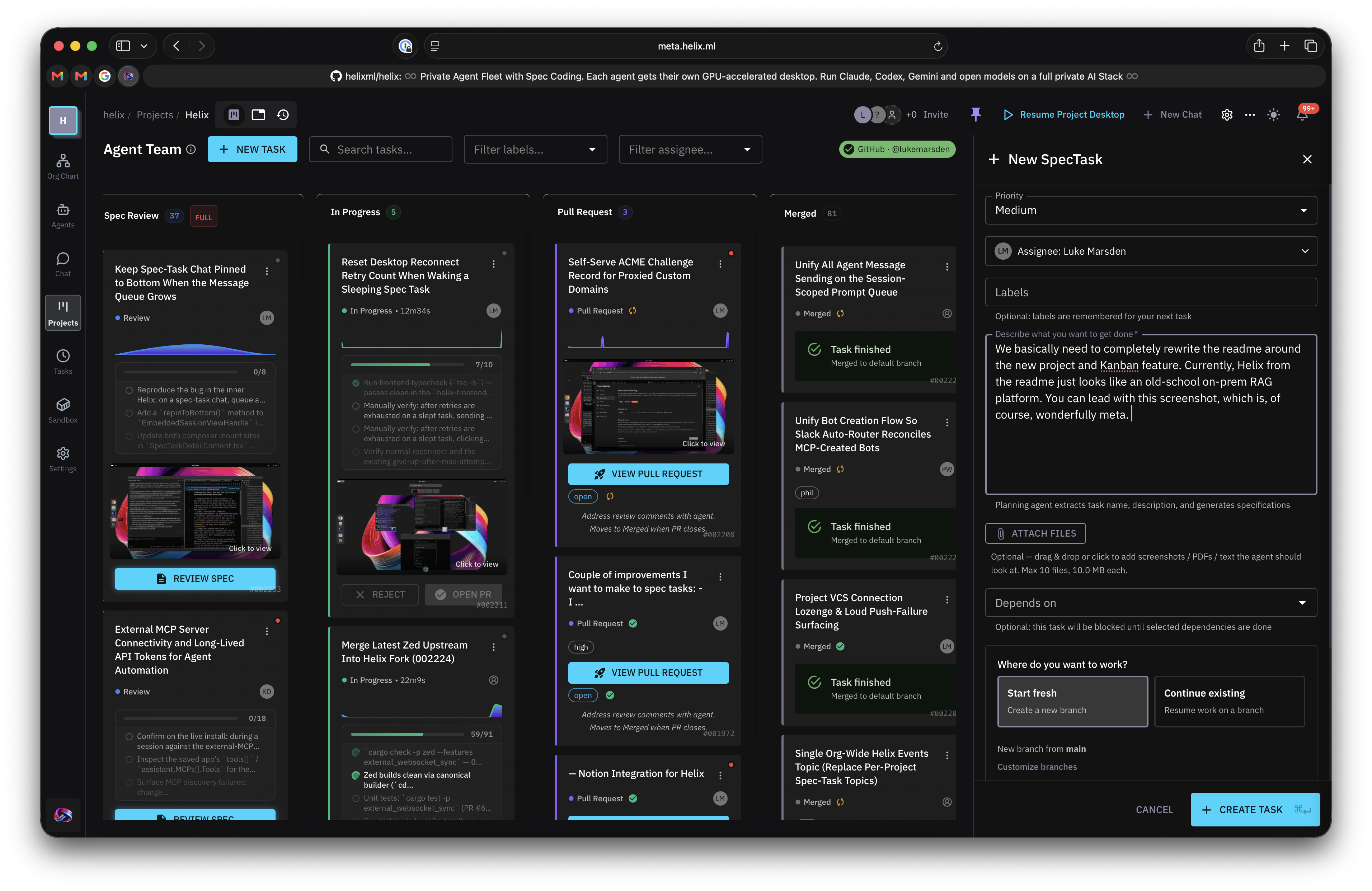
Yes, this is meta: these docs were written by a Helix agent working a spec task on a board exactly like this one — the "New SpecTask" panel on the right is where it all started.
What is Helix?
Helix is a private agent fleet with spec-driven coding: you run a fleet of coding agents on your own infrastructure, each in its own isolated environment — desktop, terminal, filesystem, and browser — and organize the work on a shared, spec-driven Kanban board.
It's about running agents on the server, not on every developer's laptop. You wouldn't hire a team of developers and sit them all at one machine — so Helix gives each agent its own computer, and your team a fleet dashboard showing what every agent is doing in real time. Your data stays on your infrastructure.
Helix hosts three kinds of agent workload:
Code agents work through development tasks: read a spec, plan, implement in an isolated sandbox, and open a pull request. Engineers set direction, approve plans, and review output. See How the agent loop works.
Agent apps are conversational assistants connected to your knowledge, APIs, and communication channels. They respond to user messages, Slack threads, webhooks, and scheduled triggers. See Build an agent app.
Helix Org workers are persistent, role-based agents that operate as part of an organisation. Workers subscribe to event streams, carry out tasks across activations, collaborate with other workers, and escalate decisions to human managers. See Helix Org.
All three share the same foundation: isolated sandboxes, fleet-level observability, and infrastructure you control.
Where it runs
| Deployment | Good for |
|---|---|
| Helix Cloud | Fastest start — sign up and go |
| Mac App | Local on Apple Silicon — credentials and code never leave your machine |
| Linux & Kubernetes | Self-hosted on your own servers or any Kubernetes cluster |
| Sovereign Server | Pre-installed rack server shipped to your data centre — zero cloud dependency |
Where to start
Evaluating Helix? → Quickstart — one tutorial, one engine, works in under ten minutes.
Building an agent app or knowledge base? → Build an agent app or Set up a knowledge base.
Setting up Helix Org workers? → Helix Org.
Mid-task and need something specific? → Guides — one guide per workflow.
Want to understand the model before making decisions? → Concepts — the why behind the how.
Deploying to production? → Deploy & Operate — install, configure, scale.