
Penetration Testing Cost in 2026: A Buyer’s Guide
Aug 31, 2026 · Updated Sep 15, 2026
Most penetration tests cost $10,000–$30,000 in 2026. Compare prices, hidden costs, testing cadence, PTaaS, and continuous security testing for AI agents.
Most organisations should budget $10,000–$30,000 for a professional penetration test in 2026. A tightly scoped test can start around $5,000. A complex enterprise assessment or red-team exercise can exceed $100,000. Synack’s June 2026 pricing guide puts the all-types average near $18,300.
Those are planning figures, not an industry tariff. Synack is a penetration-testing vendor, and its guide combines published market ranges rather than audited transaction data. A US federal regulatory analysis separately used $10,000–$30,000 as an estimate for a high-quality professional test. The overlap makes that band a useful starting point for a budget, but your scope still determines the quote.
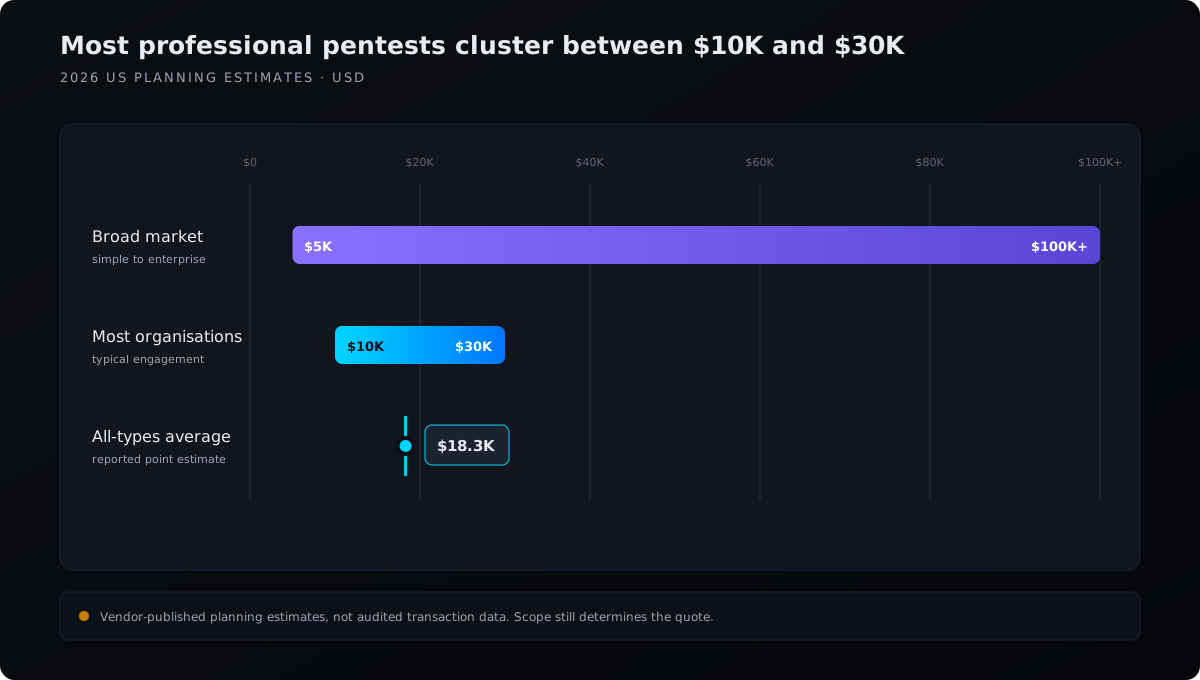
Planning estimates from Synack’s 2026 pricing guide, checked 1 September 2026. Synack is a vendor, not an independent market-data provider. Its public price list provides additional reference points from $4,181 for an AI-led test to $27,120 for a 14-day researcher-led test, before the separately priced platform.
Penetration testing cost at a glance
The most useful way to read a pentest price is as a cost for a defined amount of coverage. These US ranges come from the same June 2026 vendor guide, so they are comparable as planning brackets. They are not quotes from Helix and they do not include every possible scope.
| Penetration test type | Typical 2026 cost | What pushes the price higher |
|---|---|---|
| External network | $4,000–$12,000 | More public IPs, services and network paths |
| Web application | $5,000–$30,000 | Multiple roles, tenants, APIs, SSO and payments |
| API | $5,000–$30,000 | Endpoint count, complex authorisation and business logic |
| Internal network | $5,000–$35,000 | Active Directory, lateral movement and privilege escalation |
| Mobile application | $7,000–$35,000 | Separate iOS and Android builds, device and backend testing |
| Cloud infrastructure | $10,000–$50,000 | Multiple accounts, clouds, identities and trust boundaries |
| Red-team exercise | $30,000–$150,000+ | Multi-week objectives, stealth and physical or social scope |
| Annual PTaaS programme | $20,000–$100,000+ | Number of assets, testing windows and human validation |
The table answers “what might this cost?” It does not answer “what am I buying?” A $12,000 test of one authenticated application and a $12,000 external network test cover different risks. Compare proposals only after each vendor has the same written scope, access level, testing depth, deliverables and retest terms.
What drives the cost of a penetration test?
Scope and size
The quote grows with the number of applications, API endpoints, IP addresses, cloud accounts, user roles and environments in scope. A single-role application and a multi-tenant SaaS platform with four privilege levels may both be called “one web app,” but they are not the same amount of work.
Ask vendors to state the units behind the price. Useful units include testing days, authenticated roles, applications, API endpoints, IP ranges and cloud accounts. If the proposal only says “test the platform,” the scope is not precise enough to compare or enforce.
Testing method and access
Black-box testers begin with little or no internal knowledge. They spend more time on discovery and reproduce an outsider’s starting point. Gray-box testers receive normal user credentials and selected documentation. White-box testers may receive architecture diagrams, privileged accounts and source code.
More secrecy does not automatically produce a better security result. If the goal is to find as many exploitable flaws as possible within a fixed budget, authenticated testing and useful documentation let the tester spend fewer hours rediscovering the system and more hours attacking its trust boundaries.
Complexity and safety constraints
Multi-cloud estates, legacy protocols, unusual identity flows, payment systems and production-only behaviour all add time. So do restrictions designed to keep the test safe: narrow testing windows, fragile systems, rate limits, approval checkpoints and data-handling requirements.
Tester experience
Consultancies price senior researchers above junior testers, usually through a day rate or an internal equivalent. Ask who will perform the work, who will review it and whether named specialists are guaranteed. The team in the sales call is not always the team assigned after signature.
Reporting, compliance and procurement
A technical report with reproduction steps is different from an executive briefing, formal attestation letter or evidence package mapped to a compliance framework. Travel, expedited scheduling, procurement portals and special insurance requirements can also appear in the total programme cost even when they are absent from the testing line item.
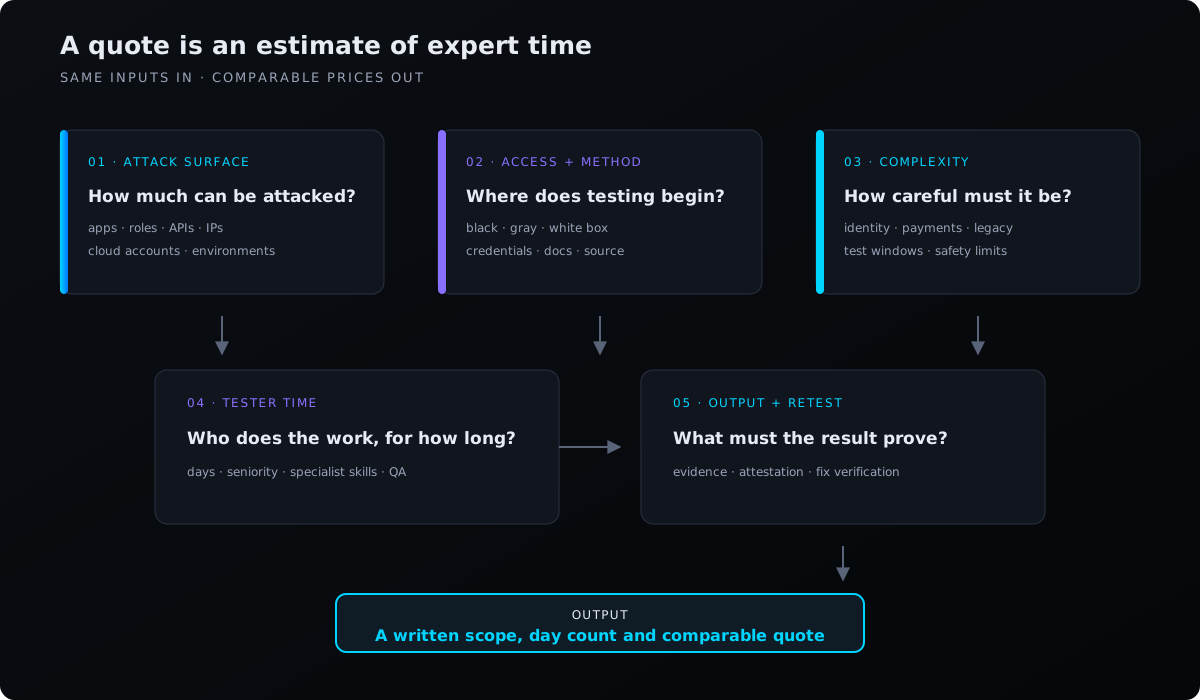
A quote is mostly an estimate of expert time. Give every vendor the same inputs for these five blocks before comparing price.
Hidden penetration testing costs
The signed quote is only part of the budget. Ask about the following before you choose a provider.
| Cost outside the headline price | Question to ask before signing |
|---|---|
| Scoping and test preparation | Who inventories assets, creates accounts and prepares test data? |
| Remediation engineering | Which team owns fixes, and how much capacity is reserved? |
| Retesting | How many retest rounds are included, and when do they expire? |
| Scope changes | What is the day rate or per-asset price for additions? |
| Expedited work | What does a fixed delivery deadline add? |
| Compliance evidence | Are the attestation letter and auditor-ready exports included? |
| Internal coordination | Who handles access, incident escalation and production safety? |
Remediation is usually the largest hidden cost. A good report can create weeks of engineering work. Budgeting $20,000 for the test and nothing for fixes produces an expensive list of vulnerabilities that remain exploitable.
Retesting also matters. PCI DSS requirement 11.4.4, for example, requires penetration testing to be repeated to verify corrections. A low quote with separately billed retests can cost more than a higher quote that includes verification.
How often should you get a penetration test?
There is no universal cadence for every system. Use three triggers together: your compliance obligations, the rate and risk of system change, and the likely impact of compromise.
PCI DSS requirements 11.4.2 and 11.4.3 give a clear example: internal and external penetration testing at least once every 12 months and after any significant infrastructure or application upgrade or change. Other frameworks, auditors, customers and cyber-insurance policies can impose different evidence requirements. Check the exact obligation that applies to your organisation instead of treating “annual” as a universal rule.
For a stable, low-risk system, an annual independent test plus testing after major changes may be reasonable. A customer-facing application that ships daily, handles sensitive data or exposes powerful APIs needs a shorter feedback loop. That does not mean buying a full consultancy engagement for every pull request. It means matching the depth of testing to the size and risk of the change.
| Trigger | Proportionate security response |
|---|---|
| Every pull request | Static checks, dependency and secret scanning, focused code review |
| Authentication, authorisation or payment change | Targeted adversarial test before release |
| New internet-facing service or major architecture change | Attack-surface review and scoped penetration test |
| Fix for an exploitable finding | Reproduce the original attack and verify the fix |
| Quarterly or another risk-based interval | Recheck high-value applications and exposed assets |
| Annual or contract date | Independent human-led test and formal evidence package |
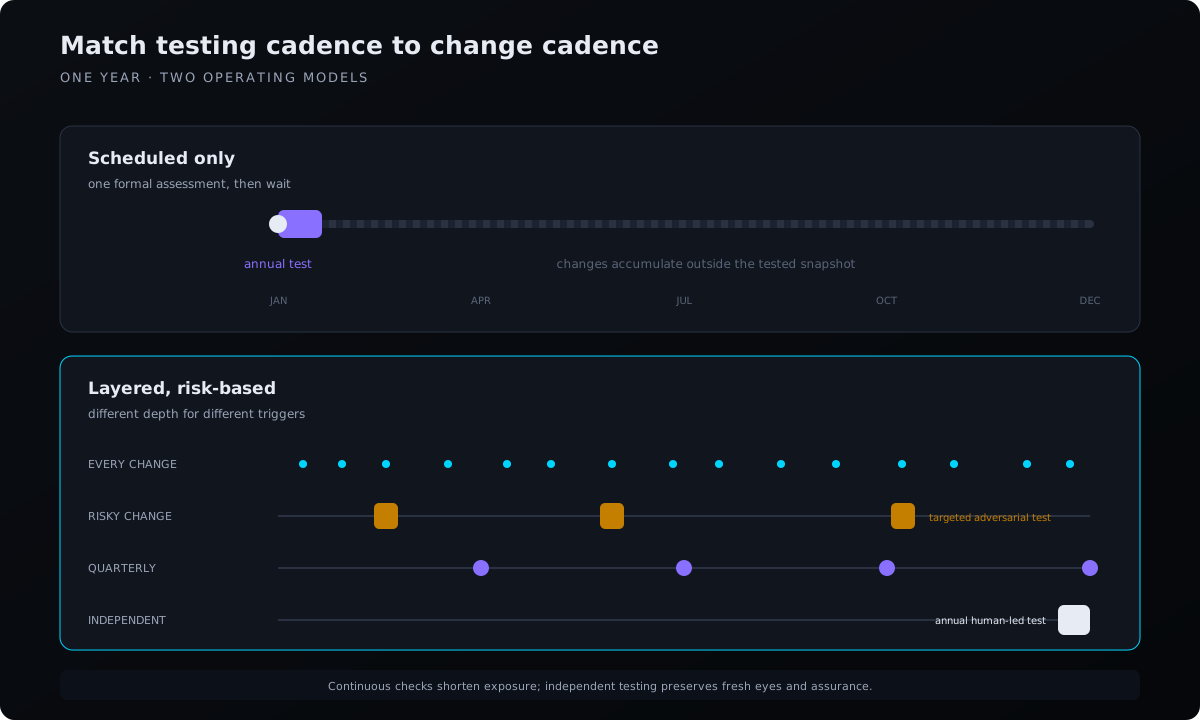
Continuous testing does not remove the independent test. It closes the gaps between formal assessments with cheaper, change-aware checks.
Why AI agents increase the need for continuous security testing
Coding agents change security cadence for two separate reasons: they increase how much software can change, and they add a new system with its own permissions and attack paths.
Agents create more changes in parallel
A coding agent can take an issue, explore a repository, edit several files, run tests and open a pull request while a developer works elsewhere. GitHub describes its coding agent as an asynchronous worker that creates commits and submits draft pull requests in the background. One engineer can therefore supervise several streams of change instead of producing them one at a time.
The security consequence is not that agent-written code is automatically worse. It is that review capacity can become the bottleneck. More pull requests, dependency updates and infrastructure edits create more opportunities for an authorisation mistake, exposed secret or unsafe configuration to pass through an unchanged annual testing budget.
GitHub’s own product changes illustrate the response. In June 2026 it extended automatic CodeQL, dependency and secret checks to third-party coding agents and said earlier validation for its cloud agent had prevented hundreds of potential leaks and vulnerabilities. Security checks moved into the agent’s working loop because waiting for a later audit would be too slow.
The agent runtime is a second attack surface
An agent does more than generate source code. It reads repository context, follows instructions, calls tools, uses credentials, accesses networks and may trigger build or deployment systems. That creates risks which a conventional web-application pentest may never touch.
The OWASP Top 10 for Agentic Applications includes goal hijacking, tool misuse, identity and privilege abuse, agentic supply-chain vulnerabilities, unexpected code execution, memory poisoning and cascading failures. Testing the product while ignoring the agent that can modify or operate it leaves half the system unexamined.
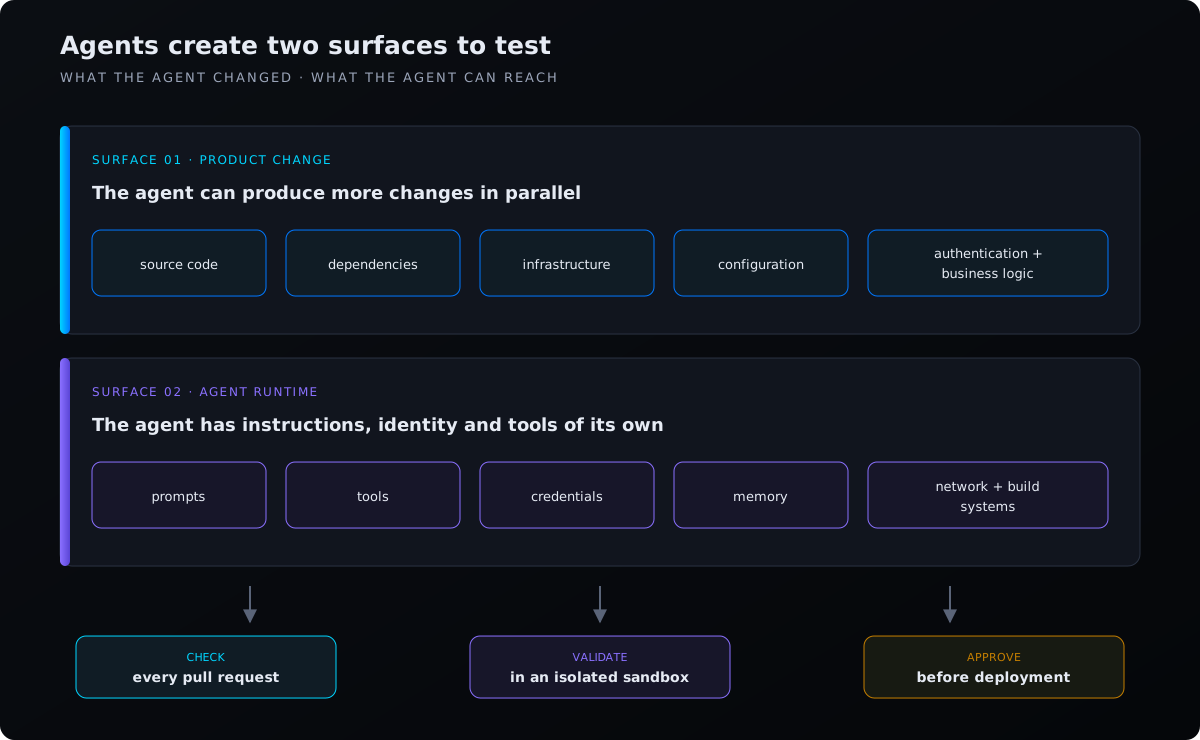
Agents add throughput and authority. Test both what the agent changed and what the agent itself can reach.
The practical cadence is layered
The answer is not a continuous autonomous attacker with production credentials. A safer programme uses several layers:
- Check every change cheaply. Run static analysis, dependency checks, secret scanning and policy tests on each pull request.
- Test risky changes dynamically. Exercise new authentication, authorisation, API and infrastructure paths in an isolated environment.
- Validate findings before creating work. Reproduce suspected vulnerabilities so engineers receive evidence, not a scanner’s guess list.
- Keep humans at irreversible gates. A person approves scope, production-impacting actions, fixes and deployment.
- Retain independent assessment. External testers provide fresh methods, separation of duties and evidence that internal automation cannot create for itself.
That stack changes the unit economics. The expensive independent engagement remains, but it is no longer the first time anyone attacks code that has been in production for months.
One-off pentest, PTaaS or continuous testing?
These models solve different buying problems.
| Model | Best fit | Main limitation |
|---|---|---|
| One-off human pentest | Stable scope, independent assurance, customer or audit deadline | Point-in-time coverage and repeated scoping costs |
| Penetration testing as a service (PTaaS) | Several assets, recurring human testing, shared findings workflow | Annual commitments and variable depth between providers |
| Automated or AI-assisted testing | Frequent releases, rapid retests, broad recurring checks | Needs evidence, guardrails and human judgement |
| Layered programme | High-change or high-impact systems that need both speed and assurance | Requires ownership across engineering and security |
Do not compare these by report count. Compare cost per covered asset, time from change to test, time from finding to verified fix, false-positive handling, retest terms and whether the evidence satisfies the people who asked for the test.
How to compare penetration testing quotes
Send every provider the same short brief, then score the answers.
- List the applications, roles, APIs, IP ranges, cloud accounts and environments in scope.
- State whether the goal is risk reduction, compliance evidence, customer assurance or a combination.
- Specify black-box, gray-box or white-box access and the production-safety limits.
- Ask for testing days, tester experience, methodology, exclusions and review process.
- Confirm the report format, evidence quality, attestation, retest rounds and expiry dates.
- Ask how findings are validated and how the provider handles false positives.
- Calculate the internal cost of preparation, remediation and coordination alongside the quote.
A cheap test can be good value when the scope is intentionally narrow. It is poor value when the scope is vague and the buyer assumes a level of assurance the vendor never promised.
Penetration testing cost FAQ
- How much does a web application penetration test cost in 2026?
- A professional web application pentest typically costs $5,000–$30,000 in published 2026 US vendor estimates. The number of roles, API endpoints, authentication flows, tenants and business-critical workflows usually matters more than page count.
- Is a $2,000 penetration test worth buying?
- It can be, if the scope and deliverable are explicit. At that price, expect a small scope, an AI-led or heavily automated service, or a vulnerability assessment rather than a multi-week manual engagement. Ask whether a human validates findings, whether exploitation is included and whether the result satisfies your customer or auditor.
- Does a penetration test include fixing vulnerabilities?
- Usually not. The standard deliverable is a report with evidence and remediation guidance. Engineering the fix is normally your responsibility, while retesting may be included, limited to one round or billed separately.
- How long does a penetration test take?
- A focused test commonly takes several testing days plus time for scoping, access setup, reporting and review. Complex scopes can run for several weeks. Calendar lead time may be longer because experienced firms book in advance.
- Can AI replace a human penetration tester?
- AI can expand discovery, repeat tests quickly and reduce the cost of checking each change. It does not replace independent judgement, safe scoping, creative attack paths, business-context decisions or compliance evidence where a qualified person is required. The strongest programme uses automation for frequency and humans for judgement and assurance.
Where Helix Fortify fits
Helix Fortify is built for the gap between formal assessments. Security agents review every commit and pull request, then validate suspected vulnerabilities in isolated desktops before raising a finding. When a fix is clear, the agent proposes it as a pull request for an engineer to review.
The goal is not to relabel a scanner as a pentest or remove the independent tester. It is to reduce the time between introducing a vulnerability, proving it and shipping the fix. The agents run open-weight models on infrastructure you control, so source code, attack traces and credentials can stay inside your environment.
Keep the annual third-party assessment for fresh eyes, independence and attestation. Add change-aware testing for the other months. See continuous penetration testing for the operating model, or Autonomous Security Teams for why security agents need isolated environments and models that can complete offensive-security work. For what AI changes about the testing itself, see AI penetration testing; for why those models need to run without a refusal wall, see Attackers Have Uncensored LLMs. Your Security Models Refuse to Help..