
Automate Your Own Job with AI
Aug 2, 2026
Automate your own job with AI - every automation wave since Ford optimised the business, never the individual, so start by reclaiming the first hour of your day.
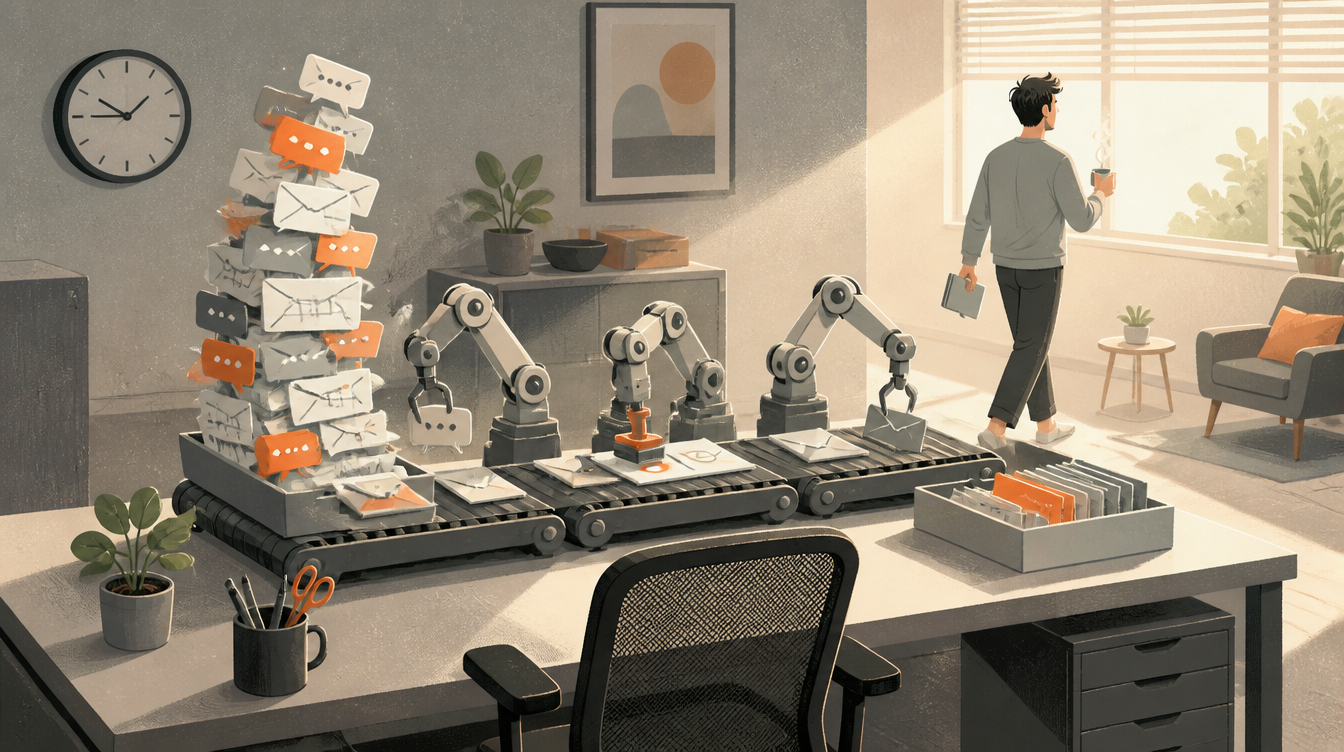
The first hour of my day is already gone
My day starts with the inboxes. I iterate through Slack, Discord and LinkedIn first, mainly because they don't demand much action — me being opinionated, sending funnies or photos of cool stuff I've done with the family, and catching up. LinkedIn is a bit different because it's a sales platform, not shits and giggles. And Discord is support. That's already a lot of variety in the first 15 minutes.
Then comes email, which usually holds business I have to action: new leads to investigate, proposals to write, legal wrangling, meetings to set up. And spam. Lots and lots of spam, promising 1,500 qualified leads a month — jokers. Then the todos in my calendar: a proposal due by such and such a date, or some legal obligation. Those usually demand real, sit-down work.
Then, after about an hour, I can finally start the work I want to do — or at least the work I'm paid to do.
Every wave of automation has skipped the individual
Automation — the word was popularised by Ford around 1946 — worked by mapping business processes and building secondary systems to do the same job without direct human intervention.
But most people no longer work inside those core processes. We're asked to handle more work with greater variety — a wire-drawing operator making pins now runs at least 16 distinct jobs. Core business processes are no longer the problem. Individual processes are.
We got here because every previous automation push improved the business and stopped there. Digitalisation converted manual, physical processes into ones a computer could control. Bespoke software then codified the business logic that had lived in people's heads and on paper. Those systems connected to other systems to take actions and perform work. ML and AI arrived to automate data-centric decisions. All of it at the scale of a business, never an individual — and even that work is unfinished, with industries like manufacturing still piloting basic automation.
An individual's work never stood a chance. AI has promised for years to automate the boring stuff, but each boring job is hyper-local and small, and it never met the return-on-investment bar of a central project. A Deloitte survey in 2018 found only 3% of businesses had automation at scale.
How much could be automated? Estimates vary wildly, and not everything can be. But one much-cited study reckons software built on LLMs could significantly speed up roughly half of all US work tasks, and McKinsey warns that 40% of US jobs could be fully automated by 2030.
The fix is guerrilla automation
I know that for many people the tasks I described at the start last all day. If that's you, I'm sorry. But you can see why no company-wide automation project is ever going to touch that eighth of my working life. And I haven't talked about the research and development I do, or the specific way I like to work. And I need to write too. These eighths of a day often add up to more than a day. I need a way to claw back time.
The fix is to look locally at the jobs being performed. Analyse the work you do as an individual, day to day, and articulate the sub-roles inside it. Then automate them, one at a time — grass-roots, guerrilla automation, at a hyper-personalised level.
If you run a business, that means giving your staff the tools and the training to automate their own jobs. They should be encouraged to do less work, not more.
What automating one sub-task actually looks like
One of the first tasks I automated was running smoke tests. I wrote a markdown document that describes, in human terms, a simple suite of acceptance tests — the kind of QA checklist you'd hand someone trying out a feature in your product. In Helix Org's QA.md, for example, there are steps to create and delete bots, create topics, use the inline chat, and verify multi-tenancy. Over time, as we gain trust in parts of the product, those sections shrink to keep execution time down.
An AI agent runs this QA process, not us. When it finds a discrepancy between the QA.md and the live product, it opens an issue in GitHub, if one doesn't already exist. The advantage is that it runs whenever you want. We run it on every new commit to main, but you could run it overnight, or any time you like. It never gets tired, it never gives up, and it keeps working when I'm on holiday.
But won't I automate myself out of a job?
When I tell people that last part — the working while I'm on holiday — their hair stands on end. It feels too good to be true, like there must be a catch. But there isn't. While I was on holiday recently, the QA bot opened a GitHub issue and an anonymous author proposed a fix.
The worry I hear most is that if you automate your job, you lose your job. 30% of workers hide their AI use for fear of exactly that.
First, the headline numbers are murkier than they look. In 2025, 55k US layoffs were attributed to AI. But attributions coming out of corporate PR offices are often AI-washing, or plain wrong. Klarna claimed its AI was doing the work of 700 support agents, then spent 2025 hiring humans back, admitting it had cut too deep. An AI-layoff headline can also pump the stock price. Much of the recent wave is economics, and automation's role is often overstated.
Second, so much can never be automated — and never should be. Where the line sits differs by context and industry, but it boils down to embodied presence, trust, and someone accountable. That's why meeting clients and colleagues just to have fun builds so much alignment and bonding: it banks trust and accountability for when the time comes, and lifelong friendships and business collaborations often emerge. Aligned outcomes are what owners and employees are both aiming for anyway. Automating the boring work leaves more room to lean into that.
Yes, there will always be businesses that cut to the bone to save costs. But that's not AI. That's necessity, or greed.
The free day you're leaving on the table
Back to my morning. If I automate just half of that first hour, I get 10 hours back every month. A free day, every month, for automating a sixteenth of my day. And that's a low bar, given all the other work I do in sales, marketing, and development.
The catch is what you do with the time. Freed-up time has a habit of refilling itself — Jevons' paradox meets Parkinson's law — and it's easy to squander the gains on busywork. Make it a conscious decision. I spend mine writing, so I've filled the time too, but I chose the filling. For your staff, it could be the innovation time you've always wanted to give them, or space to build the human connections that, ironically, might help you retain them.
Why your business should want this, not fear it
For businesses, codifying people's jobs-to-be-done into AI solves a stack of business-continuity problems at once. The one I hear most — from tech firms through to cloth manufacturers — is that staff are hard to retain. Gallup puts the cost of replacing someone at half to twice their salary, and the bill for US businesses at a trillion dollars a year.
And when people leave, they take more than their experience. They take their skills, relationships, and working style — their business persona. Hyper-personalised automation retains that persona in a limited digital form. A new hire steps into a role that still runs and does the work the same way from day one. They'll add, remove, and change parts of it, but the business continues uninterrupted.
Certifications get easier too. Some businesses live or die by audits — Sri Lankan tea plantations spend much of their time appeasing the whims of the Rainforest Alliance, because failing one would immediately cost them their premium buyers. More commonly, back offices standardise on ISO 9001 or SOC 2. Automations with named human accountability and an audit trail of operating effectiveness count as evidence.
Noise at the top, a flood at the bottom
Map your processes at business scale and these hyper-local inefficiencies look like noise. But the time lost to small, repetitive tasks explodes as staff numbers grow. The usual suspect is the communication burden. I don't think that's the whole story.
Microsoft put numbers to the flood. Its 2025 telemetry found the average employee interrupted every two minutes — 275 times a day — by a meeting, a message or an email, on top of 117 emails and 153 Teams messages daily. Nearly half say the work feels chaotic and fragmented.
In my experience, buried in that chaos is endless busywork that I now codify and outsource to an AI. And I'm one person. Automating even five minutes of one simple task, across thousands of staff, easily beats my isolated efficiencies — sharing the savings is the long-tail opportunity. The unlock for a business is getting people to do this systematically: so others benefit, so the work survives new staff and absences, and, in the extreme, so a role reaches full automation.
Start with your own morning
So start with your own morning. Not a strategy deck or a company-wide programme. Pick the smallest, most boring job in it — the one you'll do again tomorrow — and hand that one job to an AI agent. I'll write about the how in a future article.
The inefficiency worth chasing now sits with the individual, not the business process. Automating your own work won't cost you your job. The layoffs pinned on AI are mostly economics and PR, and the parts that matter — presence and trust and accountability — were never automatable anyway. And the time is real: a sixteenth of your day handed off buys back a free day a month.
This is coming whether businesses plan for it or not. Staff will automate their own work quietly, the way so many already hide the AI they use. The winners will be the businesses that ask them to do it out loud — to systemise it, share it, and keep the role running after the person has gone.
The first hour of your day is already gone. Go get it back.